QSR Industries
Published on
-9% staff costs. +22% Productivity How McDonald's optimized their businesses continuously with Nesto.
Three restaurants. Three different teams. A key challenge: mastering the balancing act between efficiency, transparency and employee satisfaction.

Company info:
About
Jörg Deitlaff runs three McDonald's restaurants as a franchisee. The focus is on operational efficiency, clear processes and reliable service quality. With a team of over 120 employees, precise personnel planning and data-based management are at the center of daily work.
The three locations are coordinated centrally, but managed individually to meet their respective requirements. McDonald's Germany operates over 1,400 restaurants with more than 65,000 employees — almost all franchisees in Germany rely on Nesto for digital workforce planning.
Industry
QSR Industries
Headquarters
Villingen
Company size
50-250
FTE
Table of Contents
Challenge
- Personnel costs fluctuated between overstaffing and understaffing — precise control was not possible
- Overtime and incorrect planning caused unnecessary costs every month
- Understaffing led to loss of service and affected the guest experience
- Scheduling was time-consuming and prone to errors
- Paperwork and short-term changes weighed on restaurant managers
- Operational management with an existing tool was barely feasible
Solution
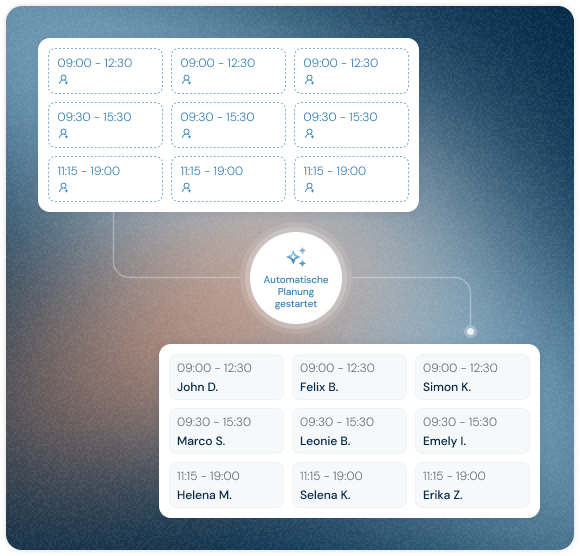
- Automated shift planning taking into account desired vacations, BDS collective agreements and qualifications
- AI forecasts predict sales and guest behavior precisely
- Live dashboard shows personnel costs and productivity in real time
- Visualization of overtime and hours for transparent and fair assignments
- Positioning Plan defines exactly which employee is deployed when and where
- Close support accompanies implementation and optimization
We looked at a few things — but none was as thoughtful and precise as Nesto. In particular, the AI-based sales forecasts blew us away. Some of them are accurate to the euro.

Jörg Deitlaff
Franchiseunternehmer der McDonald's Deutschland LLC
What
Mc Donald's
has achieved with Nesto
-9 %
All three restaurants reduced personnel costs through needs-based planning
+22 %
Sudden increase following introduction in September 2024
Down to the euro
AI-supported sales forecasts precisely meet actual values
Mc Donald's
uses Nesto for:
- Digital duty planning for three restaurant locations
- AI-powered sales and demand forecasts
- Live cost control and productivity monitoring
- Automated consideration of collective agreements and labor law
- Management of free, overtime and undertime
- Positioning plan for optimal personnel deployment management
- Central control with location-specific flexibility
All to the point
McDonald's Deitlaff has completely digitized workforce planning for three restaurants. Forecasting, shift planning and cost control are now carried out via a central system with AI-supported forecasts. The result: 9% lower personnel costs and 22% more productivity while increasing employee satisfaction.
Three restaurants, three realities — a fluctuating cost ratio
Three restaurants in different locations mean three different customer flows. Peak hours vary, teams work differently, staffing requirements are never the same. Restaurant managers had to juggle between paper plans and short-term adjustments. In particular, the crew labor rate — the personnel cost ratio — fluctuated month by month. Sometimes there were too many staff on duty, sometimes too few. Precise operational management was barely possible.
{{cards}}
The switch to Nesto in September 2024 marked a clear turning point. The change was immediately visible in the figures.
.png)
What -9% and +22% mean in day-to-day business
{{kpis}}
What these figures mean in their day-to-day work: Restaurant managers spend less time making planning corrections and more time on the floor. The crew knows in advance when they are working. Overtime is no longer caused by incorrect planning, but only through conscious decisions. Management can see where adjustments need to be made across locations — not at the end of the month, but in real time. The difference between analog planning and digital control lies not only in efficiency, but also in predictability.
.png)
The newly introduced Positioning Plan shows exactly which employee is most effectively deployed when and where.
“Since we've been using Nesto, there's no more discussion about who works where, when. The planning is much clearer for everyone — that takes a lot of pressure off.” Jörg Deitlaff
From reaction to control — data instead of gut feeling
The system is now a daily routine. No manager plans on call or on instinct anymore. The forecasts provide the basis, the platform shows the deviations, and managers make decisions based on data. What used to be a reaction is now control.
{{testimonial}}
Ready for your own success story?
Book a 30-minute call with an expert and learn how Nesto simplifies your HR processes, saving you time and money.